Guide: Getting Started with HBImed Technology
This guide supports professionals in transitioning from purely subjective assessments to objective, data-driven brain diagnostics using neurophysiological biomarkers.
Disclaimer: EEG/ERP-based biomarker analysis is not a standalone diagnostic tool, but rather supports diagnostics with additional data – with the goal of optimally tailoring the therapeutic intervention to the patient based on an understanding of brain processes.
Step 1: Comprehensive Training and Support
Building expertise is your most important investment. Even if the analysis is delegated, the practitioner must be able to explain the results to the patient in a well-founded manner. The first step is therefore to attend a course. Courses are offered, among others, by HBImed, the Swiss Brain- and Trauma Foundation, and Sadar Psychological Services. You can find an up-to-date overview here. Mentoring Experienced colleagues such as Andreas Müller (co-founder of HBImed and biomarker expert), various analysts, or Angelika/Mitch Sadar are available for supervision. Please Contact us, so that we can connect you with the specialists.
Step 2: Instrumentation: Hardware and Software
Certified hardware is essential for reliable biomarker analysis. Many EEG systems can be used for analysis with resting EEG. Contact us for an evaluation. If event-related potentials are used (which we recommend), only devices from Mitsar or BEE Medic are suitable. The BEE Medic device was developed to support database creation and biomarker research and features reference timing and data precision (www.beemedic.com).
Option 1: HBImed Reporting Service
The most convenient option. You simply send the raw data to HBImed and order a comprehensive report. While this saves you analysis time and does not require in-depth technical knowledge, we still recommend that you educate yourself sufficiently so that you can explain the reports. This option also includes the possibility of submitting completed questionnaires so that the results are included in the final report. The analysis method corresponds to that of Option 3 — you will find several sample reports there. View a sample report: Example.pdf Here is the link to Option 1: hbimed.com
Option 2: Manual Analysis (HBIdb Product)
Designed for professionals who want full control over every step and detail to compare them against the world's leading normative database. This requires in-depth expertise (courses are offered by experts such as Juri Kropotov and Olga Kara). Setup: The „HBIdb Basic Kit“ comes in a physical box with a manual, a USB license dongle, and a USB flash drive containing the software. Access & Costs: The kit includes the basic license (which does not expire and requires no ongoing payments) as well as 100 database accesses. Each database comparison consumes one access (a typical patient analysis requires one to three accesses). The dongle can be topped up online (100, 500, or 1000 accesses). Certification: The HBIdb software has CE and FDA approval, which is unique in this field. Compatibility: You can also use WinEEG, the software developed under the direction of Juri Kropotov, as we are fully compatible with it. Here is the link for option 2: hbimed.com.
Option 3: Brain Function Analyzer (Cloud / Report Generator)
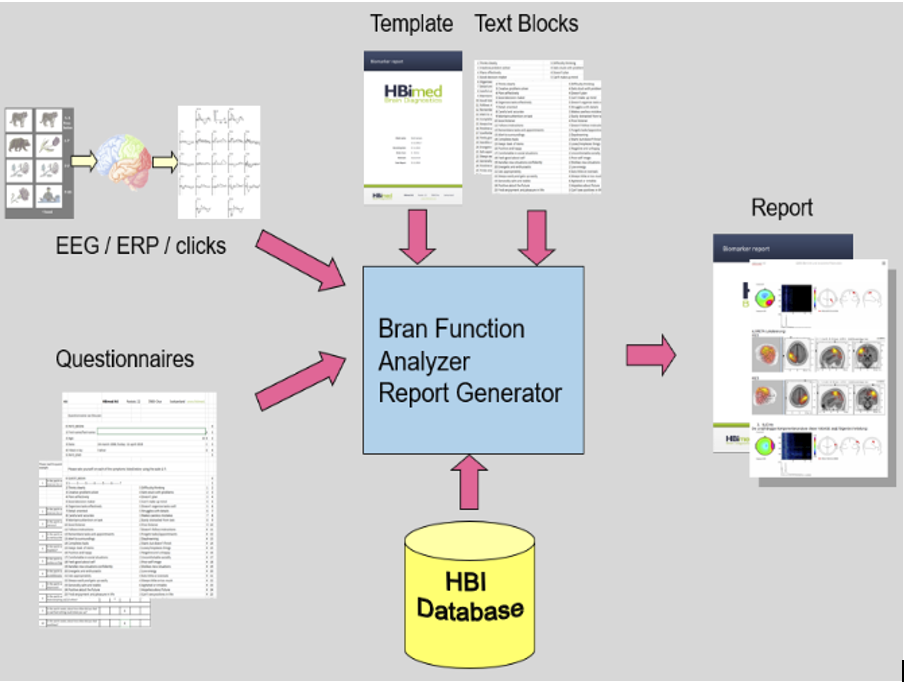
This is the recommended option. In terms of time required, it represents a „middle ground“ between manual analysis and the full reporting service. This extremely comprehensive cloud package, available online via remote server access, represents the future of brain function analysis. This option also enables the import and analysis of questionnaires. (The clinical workflow typically begins with specialized questionnaires (currently available in English, German, French, and Japanese). These are filled out directly in Excel and automatically evaluated by the software.) Automation: All steps that can be automated are handled by the system. Questionnaire integration: Questionnaires are imported and automatically evaluated according to the manual, with the results flowing seamlessly into the final report. Customization: You can adapt the appearance and scope of the report to your specific requirements using your own templates. Current Biomarkers: The databases stored on the cloud server are constantly updated with the latest biomarker research findings from Andreas Müller, making them more modern and comprehensive than the local HBIdb. AI Copilot: A newly integrated, advanced AI tool trained on thousands of manual reports. It further simplifies the creation of high-quality reports and requires less detailed technical knowledge from the user. With this option, you can fully customize the appearance of the report as well as its content and length. The report is based on a Word template that can be tailored to your needs (color scheme, logo, fonts, general structure, content, length). Here are some examples of such customized reports (courtesy of the authors): – Brain Training Institute – Sadar Psychological Long Version – Sadar Psychological Short Version – BrainARC Report Here is the link to Option 3: hbimed.com